What Is Blue Hour? How to Photograph Twilight Light
Blue hour is the short window after sunset when the sky turns deep blue and city lights glow. See why it happens and how to shoot it with any camera.
Everyone chases golden hour. Photographers who have been at it a while quietly love the twenty minutes after it, when the sun is gone and the sky doesn't want to let go of the day.
That's blue hour, and it's one of the easiest ways to make an ordinary street look like a film still.
What blue hour actually is
After the sun drops below the horizon, the sky doesn't go dark right away. Sunlight still bounces through the upper atmosphere and reaches you as soft, indirect light. For a short stretch, the sky glows a deep blue and the light on the ground is gentle, with almost no hard shadows.
It happens twice a day, once before sunrise and once after sunset. Scientists point to the way sunlight passes through the atmosphere. Ozone high above us absorbs some of the orange and red light, which leaves the blue behind.
Why the name is misleading
It's not a full hour. Depending on where you live and the time of year, the best of it is often around 20 to 40 minutes. Close to the poles it can stretch much longer in some seasons. Check a sun-times app for your own location and plan to arrive early.
The secret ingredient: warm lights in a blue sky
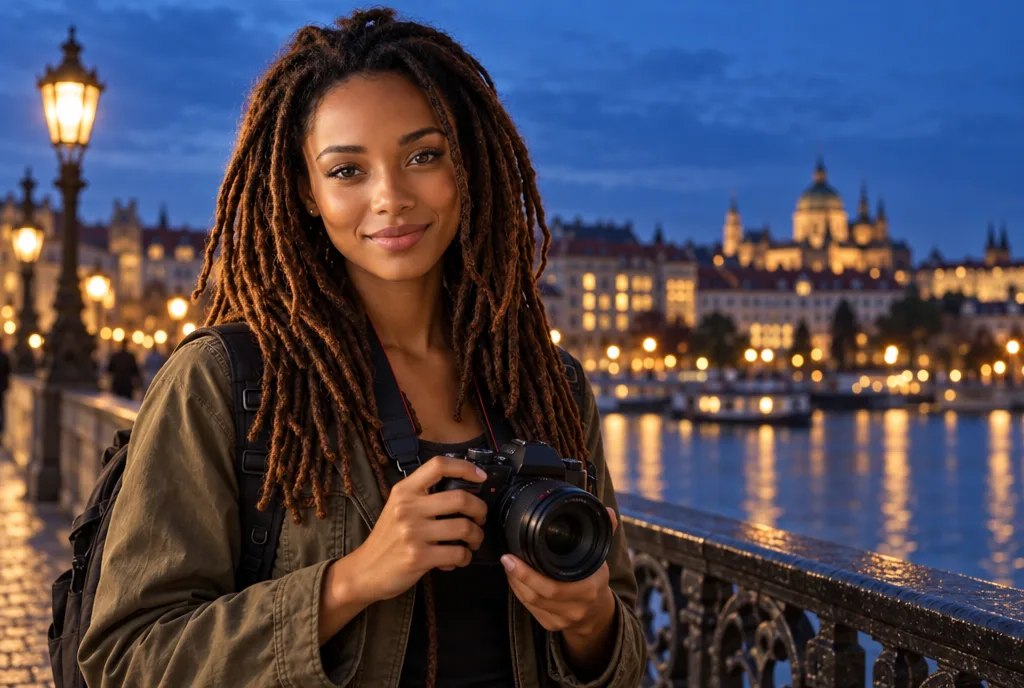
Blue hour looks best when you have something warm against the blue: lit windows, street lamps, car headlights, a lantern, a shop sign. The contrast between cool sky and warm light is what gives these photos their cinematic feel.
That's why cities, bridges, harbors and quiet suburban streets work so well.
How to shoot it
You don't need a special camera. Here's what matters.
- Steady your camera. The light is dim, so your camera will choose a slow shutter speed. A tripod is ideal. A wall, a railing or a bag on the ground works too.
- Use a low ISO when you can. Lower ISO means less grain. Raise it only if you cannot keep things steady.
- Expose for the sky. If you let the camera expose for the dark ground, the sky turns washed out. Tap the sky on your phone, or lower your exposure a touch.
- Keep your white balance cool. Auto white balance often tries to "fix" the blue and turns it gray. Try the daylight setting, or just lower the temperature in editing.
- Shoot a lot. The light changes by the minute. A frame at the start of blue hour and one ten minutes later look like two different places.
Compose with the fading light in mind
Blue hour changes fast, so decide your frame before the sky gets dark.
- Leave room for the sky. The color gradient from deep blue at the top to a pale glow at the horizon is the star of the picture, so give it space.
- Look for reflections. Wet pavement, a river or a window doubles the glow and the lights.
- Add a person or a silhouette. A figure on a bridge or in a doorway gives the scene a story and a sense of scale.
- Stay a little longer. Many of the best frames come just after you think the light is gone.
Using a phone
Modern phones are very good at this. Turn on night mode if it doesn't switch on by itself, hold still for the whole exposure, and use a ledge as a tripod. Lock focus on a lit object so it doesn't hunt in the dark.
A simple exercise
Pick one spot you pass every day. Photograph it at golden hour on one evening. The next evening, stand in the same place, wait until the sun is gone, and photograph it again about 15 minutes later. Compare the two. You'll see how much of a photograph is the light, not the place.
Golden hour is a warm hug. Blue hour is a quiet secret.
Quick answers
What is blue hour in photography?
Blue hour is the period just before sunrise or after sunset when the sun is below the horizon but the sky still glows with a deep, soft blue light.
How long does blue hour last?
Despite the name it is rarely a full hour. It is often somewhere between 20 and 40 minutes, and it varies with your latitude and the season.
Do I need a tripod for blue hour photos?
It helps a lot, because the light is dim and your camera will use slow shutter speeds. Without a tripod, rest your camera or phone on a wall, a railing or the ground.